
Polk County Parole Versus Probation
Parole and probation both place a person in the community under rules, but they begin under different legal authority. Probation is a sentence imposed by a court. It may follow a short jail term or replace confinement. Parole applies mainly to older or indeterminate Oregon prison cases and other matters within the Oregon Board of Parole and Post-Prison Supervision's authority. Many people leaving a modern determinate state-prison sentence serve post-prison supervision instead of parole.
Polk County Community Corrections performs local field supervision for all three categories. That shared office does not make the terms interchangeable. The source record controls the label, start date, conditions and end date.
| Supervision | Source of authority | Best confirming record |
|---|---|---|
| Probation | Oregon court judgment | Judgment and register of actions |
| Parole | Oregon Board order | Board Action Form or final order |
| Post-prison supervision | Sentence and corrections law | Judgment plus ODOC supervision record |
- Parole
- Conditional community release in a case under the Board's release authority.
- Probation
- A court sentence served in the community under stated conditions.
- Post-prison supervision
- Community supervision that follows many determinate Oregon prison terms.
- Discharge
- The formal end of the legal sentence or supervision term.
Verify Polk County Post-Release Supervision
Start with Oregon's current Victim Information System in Oregon, known as VISOR. Its stated scope includes people who are now in custody or under supervision. Search by SID or county ID when possible because names can match. A VISOR result is a strong lead, but the legal record still determines whether the status is probation, parole or post-prison supervision.
- Search VISOR by full or partial name, SID, or county ID, then compare all available identifiers.
- For probation, find the Polk court judgment and review its term, conditions, amendments and termination entries.
- For parole, obtain the Board Action Form or final order. For post-prison supervision, check the judgment and ODOC record.
- Contact Polk County Community Corrections to confirm the assigned-office route. Staff may withhold protected case details.
- When past status or final discharge matters, request the official court, Board, or ODOC document rather than relying on portal absence.
The broader Polk County released-inmate search path helps when the first question is whether the person left county jail, transferred to ODOC, or reached the community.
Polk County Supervision Office
Polk County Community Corrections works with courts, law enforcement and the Oregon Board of Parole and Post-Prison Supervision. The county reports an approximate caseload of 625 felony and misdemeanor clients and identifies reduced supervision, sex-offender supervision and community service among its programs.
The official county Community Corrections page shows the local office and its supervision role:
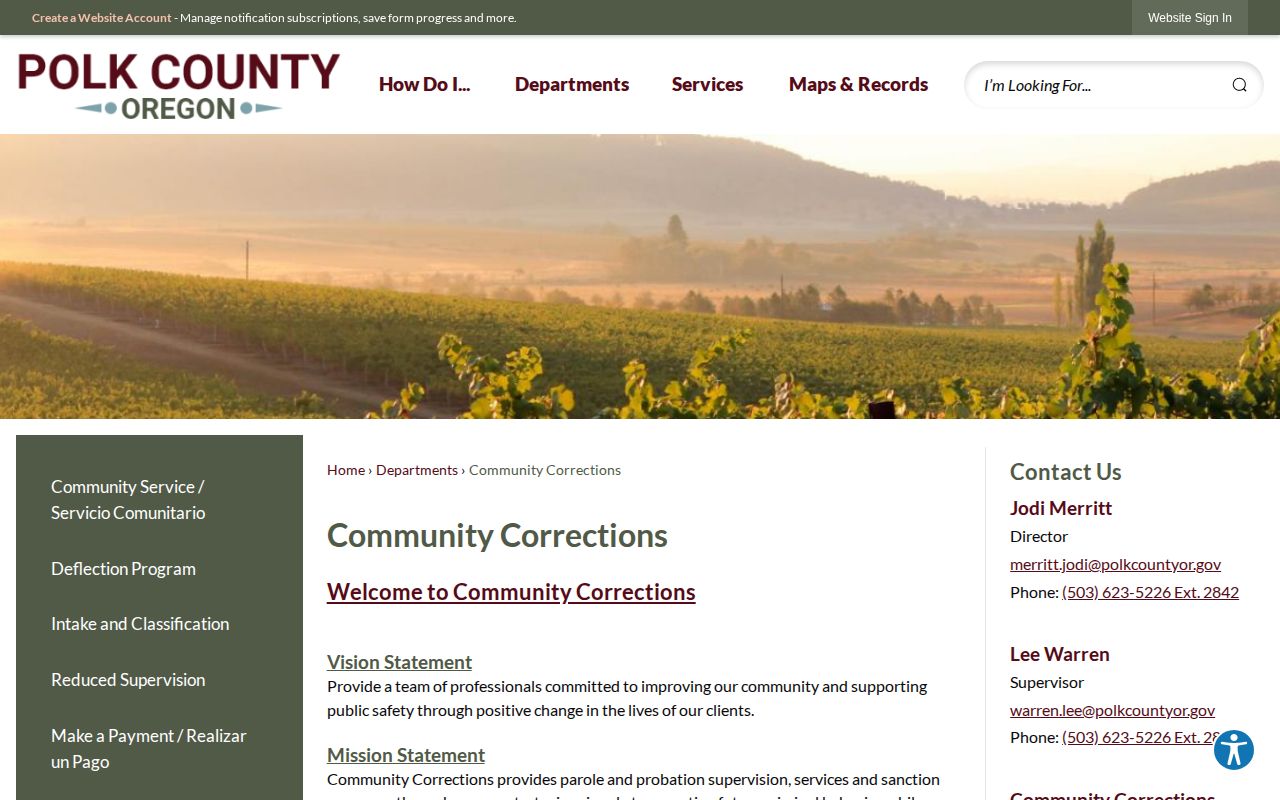
820 SW Church Street, Suite 100
Dallas, OR 97338
Phone: 503-623-5226
Fax: 503-623-5326
Monday through Friday, 8:00 a.m. to 5:00 p.m.
Call the office for routing and reporting information. A local office contact is not a substitute for the signed judgment or Board order, and staff may not release protected facts about a person's case.
Polk County Parole Board Records
The Oregon Board hearing calendar lists scheduled hearings, including the person, hearing type, institution and date. It does not prove that release was granted. A calendar entry means only that a hearing was set. Since May 7, 2025, hearings generally occur in person at Oregon State Penitentiary or Oregon State Correctional Institution, with approved remote roles and advance approval for observers.
There is no verified public name-searchable decisions database. The authoritative outcome is a Board Action Form or final order. Submit a Board records request with the full name, SID, hearing type, approximate action date and exact order sought. The Board's field key identifies such items as the SID, action number, hearing date, institution and adjusted inception date. Most adult-in-custody records are listed with a 25-year retention period and most Board records with ten years, though the requested series controls.
Hearing types also matter. A Prison Term hearing may set a projected parole date under older law. A Personal Review may reduce a term for outstanding reformation. Parole Consideration can set a date or schedule another hearing, while an Exit Interview can affirm or defer a projected date. Parole Postponement addresses serious misconduct, and Future Disposition follows revocation. A favorable Board result may still be followed by release planning, conditions or another lawful hold.
Board jurisdiction is limited. It chiefly covers offenses committed before November 1, 1989, aggravated murder, dangerous-offender sentences and certain murder sentences with long minimum terms. Oregon also has a distinct juvenile-offender eligibility route for qualifying cases. The offense, judgment date and sentence control, so one general eligibility formula cannot resolve every Polk County parole case. Match the SID, retrieve the order, then confirm the later custody and supervision events.
Polk Supervision Violations and Absconders
Supervision conditions come from the judgment, Board order and case plan. The exact duties are person-specific and must be read from those records rather than inferred from a general supervision label. An alleged violation may cause a Polk County Jail stay without ending supervision.
A violation hearing determines whether a breach occurred and what response follows. Possible results include custody, added conditions, local sanctions or continuation under the existing plan. An absconder is a person alleged to have stopped reporting or whose location is unknown. It is not a release category and does not itself prove a new conviction.
No separate Polk County public absconder list was found. Use the official ODOC Corrections Most Wanted source where relevant and verify a warrant through the responsible court or agency. Rumors and copied lists do not establish current status. VISOR may show active supervision, but an agency record is the sound route for a warrant or violation decision.
Note: A roster entry may reflect a supervision hold, while the court or Board record explains why custody resumed.
Polk County Reentry Supervision Programs
Polk County's local model is more than a distant state contact. Community Corrections names reduced supervision, sex-offender supervision and community service as programs and coordinates with county courts, law enforcement and the Board. That network helps route people from a court judgment or prison release into the correct local supervision track.
Program placement should not be inferred from a person's name or offense alone. The judgment, corrections record and assigned officer determine the actual plan. A person released from Polk County Jail on probation has a different source record from a person transferred to ODOC and later returned to Polk County on post-prison supervision.
The distinction also affects timing. Physical release from prison can occur before the sentence is discharged. A person may report to Polk County Community Corrections, move to another county's office, begin Short-Term Transitional Leave, or be taken on a detainer. Record both the custody event and the legal supervision status.
Property Before Polk County Release
The Polk County Jail instructions explain that pocket property is sealed as one small-property bag. Staff will not open that bag so selected items can be removed. While the owner remains in custody, the person may authorize release of the full bag or money on the required form. The recipient goes to Door 4, marked Bail/Release, uses the speaker and shows identification.
Property pickup does not prove that the owner left custody. A current inmate can authorize the transaction. On final release, Polk County Chapter 48 requires jail staff to reconcile property and the person's money account as part of processing. The property event and the release event should therefore remain separate.
For a disputed final-release record, ask Jail Records for the release log and signed jail-file documents. Those records identify the actual time, authority and destination. Property handling can support the timeline, but it does not replace the custody record.
Ending Polk County Post-Release Supervision
Supervision ends through formal action, not merely because a portal result disappears. A probation case calls for the court judgment, register of actions and termination order. A parole matter calls for the Board Action Form or final order. An ODOC discharge record is the stronger historical proof for post-prison supervision.
The Oregon Public Records Law, ORS 192.311 through 192.478, governs access to nonexempt agency records and allows actual-cost fees. Protected, sealed, medical, safety-sensitive or other exempt details may be redacted. Ask for segregable public fields and identify the SID, court case, date span and precise discharge document.
A fully discharged person may no longer appear in VISOR because its search scope is current custody or supervision. Absence is not proof that a record was destroyed. Match the final order to the correct person, then distinguish the end of physical custody from the later end of the sentence.
When requesting a past status, state the record series instead of asking an office to draw a broad conclusion. For probation, ask the court for the judgment and any termination or revocation order. For parole, identify the Board Action Form by SID and approximate action date. For post-prison supervision, ask ODOC for the supervision start and discharge records. This phrasing gives each custodian a concrete document to locate and keeps the three forms of Polk County supervision distinct.
Note: Final discharge requires the record from the court, Board, or corrections agency that had authority over the supervision term.