
Polk Projected Versus Actual Release
A projected date is a forecast based on the judgment and the credits, restrictions, and other legal facts known when the agency makes its calculation. The Polk County Jail roster may show a release date for a sentenced person. The Oregon Department of Corrections also publishes a date for a person serving a state sentence, and its public materials call that a projected release date. The public offender detail screen has also used the label “Earliest Release Date.” Read the label that is actually shown. Neither field records the exact time a person walked out.
An actual Polk County release is documented only after staff verify the authority, check for detainers, reconcile property and money, and complete the release entry. The jail procedure then calls for removal from the active roster. A person can leave Polk County Jail yet remain confined after transfer to state custody, another county, or another agency. The release log's authority and destination resolve that difference.
Pretrial detainees are a separate group. They have not begun a sentence-based term, so bail, dismissal, a release order, a plea, or another court action controls their exit. A roster may show court and bail information without offering a fixed release date. Asking staff to calculate one before a judgment would treat an uncertain court event as a sentence computation.
Find a Polk Projected Release Date
Begin with the custody type. The same name can be tied to a local booking, a later state-prison sentence, and community supervision. Polk's live roster is for current jail custody. The Oregon Offender Search is for ODOC cases, not every person who was booked locally. The judgment supplies the sentence terms that either agency must apply. Use matching identifiers such as the five-digit county inmate ID, SID, booking number, date of birth, and court case number.
- Check the Polk County current-custody roster once. If the person is sentenced locally, record the displayed release-date label and five-digit inmate ID.
- For a local term, review the court judgment and call Jail Records at 503-623-9254. Ask whether the date is still scheduled and whether another hold changes the destination.
- For an ODOC sentence, open the Oregon Offender Search. Search by SID when possible, match identity, and record the exact date and status labels.
- Use VISOR to watch custody or supervision changes. VISOR is limited to people in custody or under supervision and is not a permanent archive.
- After the date passes, request the Polk release log or ODOC release record. This final check separates community release from transfer to another authority.
The broader Polk County released-inmate search explains the court, federal, and records-request branches when the custody source is not clear. A named-person inquiry to Polk Jail Records should ask for the actual date and time, release type, legal authority, and receiving person or agency. Those fields answer more than a roster disappearance can.
The official Oregon Offender Search screen shows why identifiers and the live field label matter.
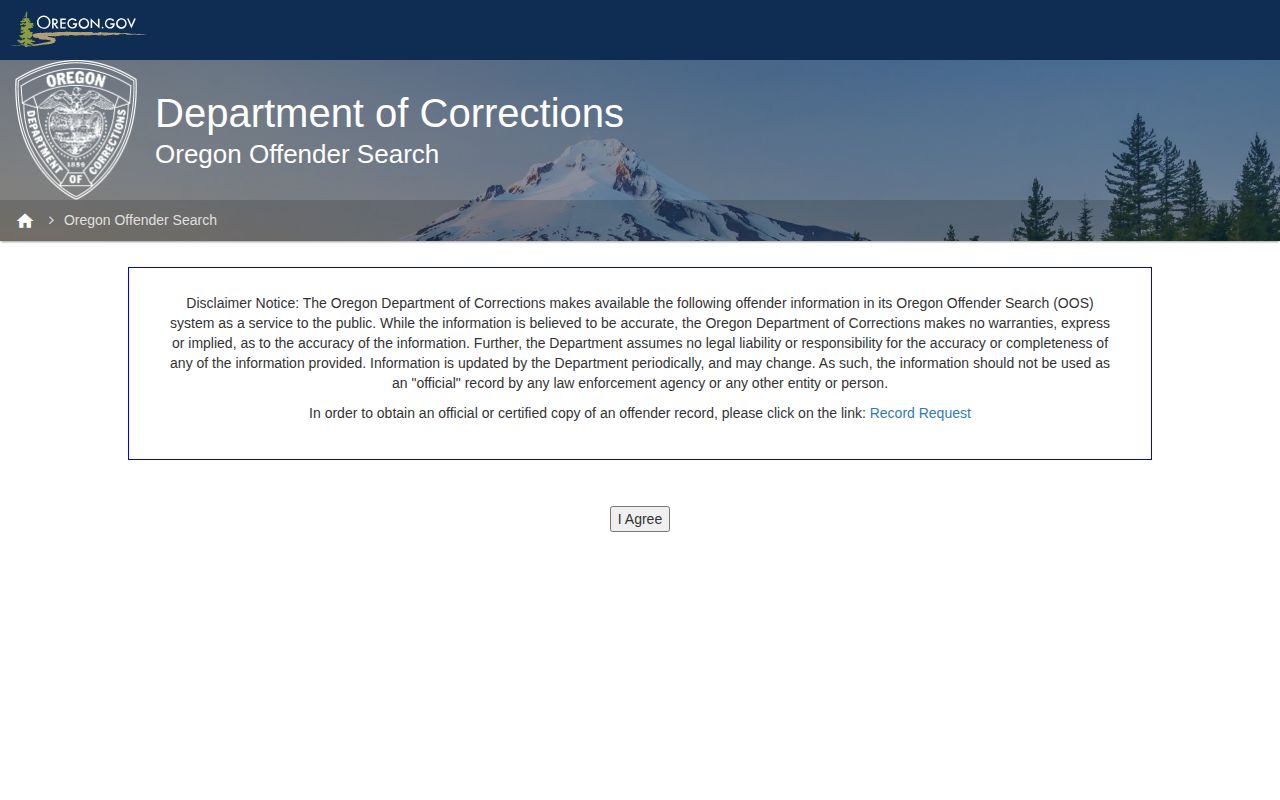
The portal image is a starting point for a state-prison date. It does not replace a certified ODOC record or prove release from Polk County Jail.
Oregon Prison Release Date Credits
ODOC starts with the judgment, when the sentence legally began, presentence credit, and whether terms run at the same time or one after another. It then applies only the credits and programs allowed for that sentence. Under ORS 421.121, an eligible adult serving a qualifying felony sentence may earn a reduction for appropriate conduct and participation in basic-skills work. The statute allows a maximum reduction of twenty percent of total incarceration under ODOC and does not permit actual prison confinement below six months.
That maximum is not available in every case. Measure 11 mandatory minimums under ORS 137.700 and other listed sentencing laws can exclude or change earned-time eligibility. Oregon therefore has no sound blanket rule that every prisoner serves about eighty-five percent. Some eligible terms may be reduced by as much as twenty percent. Other terms require the full minimum. Applying one percentage to all Polk County cases can produce a false date.
- Presentence credit
- Time credited in the judgment for qualifying custody before the prison sentence began.
- Earned time
- A possible ODOC reduction tied to statutory eligibility, conduct, and program participation.
- Mandatory minimum
- A minimum term that cannot be reduced through ordinary earned-time rules unless the law permits it.
- Discharge
- The end of the legal sentence or supervision, which may occur after physical prison release.
Short-Term Transitional Leave is another distinct path. It can move an eligible person from prison confinement to structured community placement before the projected sentence end, while legal authority continues. Physical location, supervision, and final discharge should be recorded as separate facts.
Polk Jail Good-Time Calculations
A local Polk County Jail term follows county-jail rules, not the ODOC earned-time percentage. ORS 169.110 gives the sheriff or custodian discretion to reduce a definite sentence for good conduct through a tiered schedule. Sentences from ten through thirty days may receive one day per ten. Longer terms use larger credits per thirty-day segment, rising through the tiers stated in the law. County authorization also matters for deductions in an alternative sentencing facility.
Presentence credit is governed separately by ORS 137.370. The court judgment is therefore essential. It shows the term imposed and the credit the agency must honor. The roster's expected date reflects the current calculation, but Polk's Chapter 48 log remains the record of the completed event. Do not subtract days from a sentence by hand and publish the result as official. An amended judgment, forfeited credit, or another legal hold can defeat that arithmetic.
| Polk custody | Date source | Final proof |
|---|---|---|
| Pretrial jail custody | Court or bail event, often no fixed date | Polk release log |
| Local jail sentence | Judgment, jail calculation, sentenced roster field | Polk release log and jail file |
| State prison sentence | Judgment and ODOC projected or earliest date | ODOC physical-release record |
| Community supervision | Court, Board, or ODOC order | Termination or discharge record |
Note: County good-time authority and ODOC earned time are different rules, even when the same Polk County court case led to custody.
Why Polk Release Dates Change
A projected release date uses facts available at one point in time. Later legal or administrative events can change the calculation. Some events move the day itself. Others leave the day intact but alter what happens next. A detainer, for example, may cause Polk or ODOC to deliver the person to another authority rather than release the person into the community.
| Factor | Possible effect | Record to check |
|---|---|---|
| Amended judgment or corrected credit | Moves the computed sentence date | Court judgment and register |
| Earned-credit award or loss | Advances or delays an eligible ODOC date | ODOC calculation or record |
| Concurrent or consecutive terms | Changes how multiple terms combine | Judgment and ODOC computation |
| Program entry or removal | May change an authorized transition path | ODOC case record |
| Board action | Affects limited parole-jurisdiction cases | Board Action Form or final order |
| Detainer or new warrant | May change destination or extend custody | Release log and receiving agency |
The Oregon Supreme Court interpretation discussed in ODOC's current sentence-recalculation materials is a real example of a date changing without a new offense. ODOC says it reviews qualifying sentences after the decision and updates OOS. The judgment must expressly allow certain overlapping time-served credit under ORS 137.370(4). Because the review is case-specific, a portal change should be saved and then confirmed with ODOC if the date has legal importance.
The ODOC sentence-recalculation FAQ is the official explanation of the ongoing review and public date update.
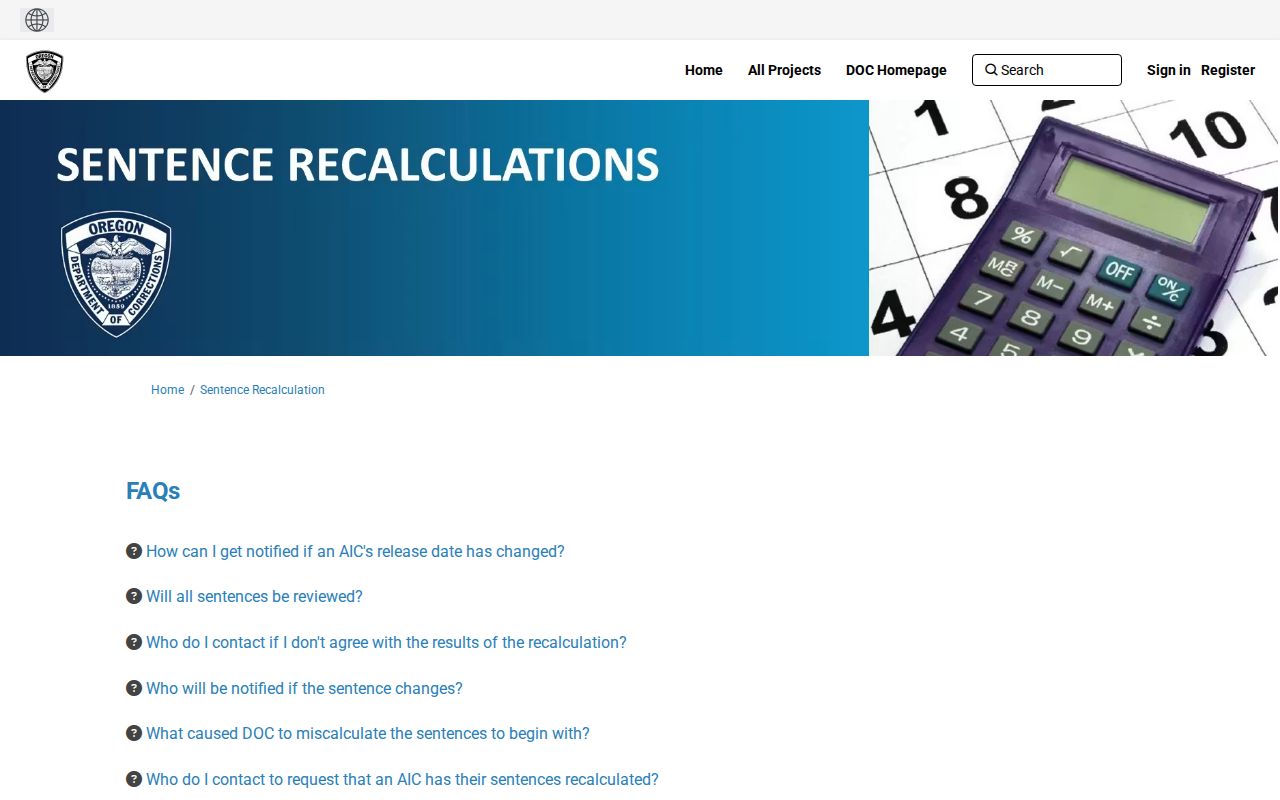
This captured explanation supports checking the live offender result again instead of relying on a date copied before recalculation.
Polk Weekend Release Timing
Oregon law adds an operational wrinkle when a release date falls on a weekend or legal holiday. ORS 137.375 allows an ODOC or county or city jail authority to release on the first, second, or third preceding day that is not a weekend or holiday. The word “may” matters. It is authority to choose an earlier working day, not proof that Polk County always selects the earliest one.
A different rule applies to a county or city prisoner serving a mandatory minimum that is specifically limited to weekends. That person is released only at the time fixed by the sentence. For all cases, verify the chosen date with the holding agency rather than moving the displayed date on a calendar yourself.
Weekend timing can also affect court orders, bail confirmation, transport, and records-office access. It does not turn a transfer into a community release. If another authority takes custody on the scheduled day, the Polk or ODOC record should identify that destination.
Polk Sentence-End Release Time
Polk County's written jail procedure supplies a local detail that a date-only lookup cannot show. A person completing a local sentence is ordinarily processed between 7:00 and 8:00 a.m. unless another time is directed. That window concerns the release operation after the sentence calculation. It does not decide how much good time applies or when the sentence legally ends.
Staff still verify release authority and detainers, complete the intake-log entry, reconcile property and funds, and remove the name from the active population. The person normally leaves through the east-side intake area. A bail or court-authorized release follows receipt and verification of authority rather than the ordinary sentence-end window. Those different paths explain why a projected day cannot promise an exact exit minute.
Polk release timing joins three distinct layers: county good time under ORS 169.110, presentence credit under ORS 137.370, and the Chapter 48 processing window. Keeping them separate makes the date easier to verify and prevents an operational practice from being mistaken for sentencing law.
Confirm a Polk County Release
For a pending state or participating local custody event, register through the Polk County VISOR notification process. Oregon replaced the old public VINELink brand with VISOR. Alerts may report release, transfer, or a date change, and ODOC says relevant notifications operate on an approximately two-hour cycle. That is useful notice, but it is not instantaneous proof.
After a local jail date passes, call Polk Jail Records or use the Request Inmate Information form. Ask for actual release date and time, booking number, charges released on, release type, authority, and any receiving person or agency. For a state-prison event, request admission, physical-release, supervision-start, and discharge records through the ODOC Public Records Center. Each date answers a different question.
Final discharge can occur after physical prison release because parole, probation, or post-prison supervision may continue in the community. VISOR may still show a person under supervision. A court termination, Board Action Form, or ODOC discharge record is stronger evidence that the legal supervision ended. Absence from a search should never be converted into a release date.
Note: Save the date label and capture time, then verify the completed event with Polk County Jail, ODOC, or the receiving agency.